
// case note
UnmetRadar: auditable market-research engine
Market-research backend where every conclusion carries its evidence
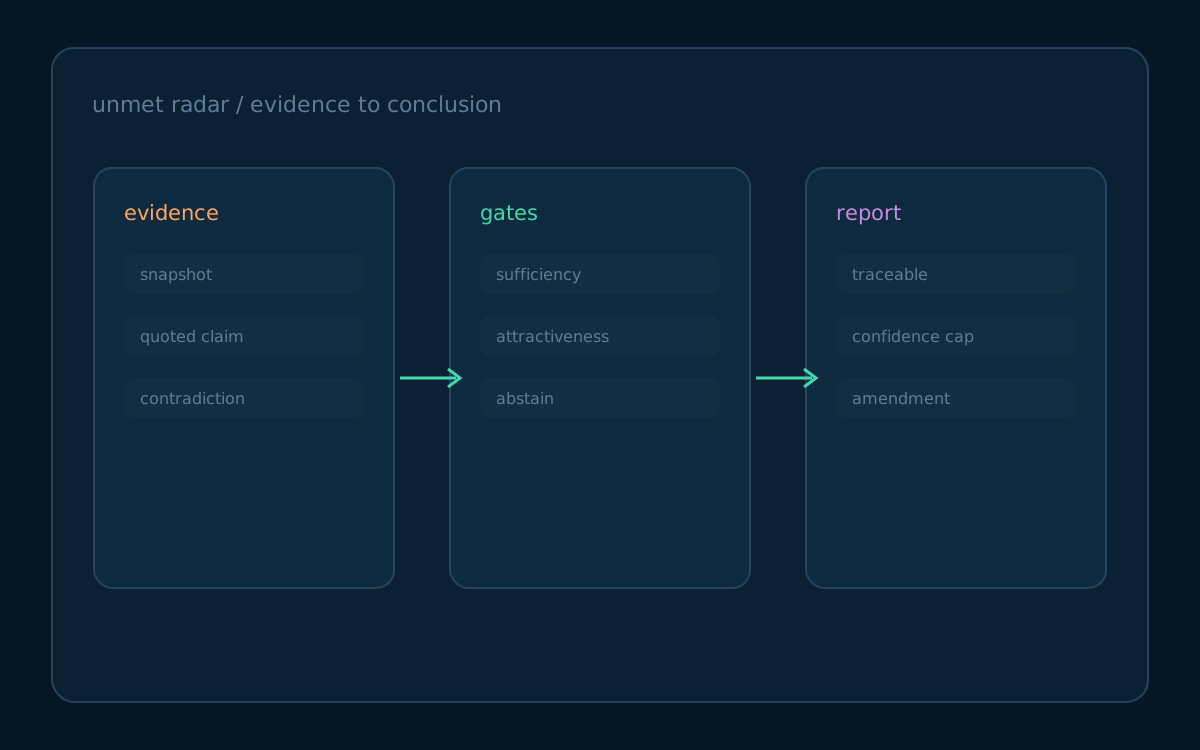
A backend engine that turns collected evidence into market-research conclusions, each one traceable to the source it came from.
Solo design and implementation: database schema and migrations, multi-tenant security model, job pipeline, AI workflow orchestration, and the test and evaluation harness.
Separating whether there is enough evidence from whether the opportunity is attractive meant building two independent gates, and proving tenant isolation in the database rather than trusting application code to remember it.
_context
UnmetRadar is the backend engine for a market-research tool that assesses whether a business idea is worth building and, just as importantly, refuses to give a confident answer when the evidence behind it is too thin. Individual scores abstain rather than guess, contradicting evidence is reported alongside supporting evidence, and a human correction is filed as an attributed amendment instead of quietly overwriting the earlier report. Work started in July 2026. It runs today as a command-line tool and a background worker: there is no interface yet, evidence is still registered by hand, and it has never been deployed or used by a customer.
_contribution
I build the system solo: the PostgreSQL schema and its reviewed migrations, the row-level security model that isolates each customer's data, the durable job pipeline, the orchestration layer around model calls, and a test suite that runs against a real database rather than a mock.
_what-I-built
- A PostgreSQL schema of roughly 150 tables with 44 hand-reviewed migrations, database-level constraints, and forced row-level security for tenant isolation.
- A boundary-enforced modular monolith: eleven domain modules behind single public entry points, with import rules checked automatically rather than left to convention.
- A durable job pipeline and an orchestration layer for bounded AI workflow steps, with every model call routed through an owned adapter, a permit check, and a cost ledger.
- A test and evaluation harness: suites running against a real database in containers, plus cross-model evaluation matrices covering traceability, contradiction handling, and prompt-injection resistance.
_what-it-demonstrates
- Multi-tenant isolation proven rather than asserted: row-level security is forced on 142 tables, and a test boots a real PostgreSQL instance under a role that cannot bypass it, so a new table cannot ship without protection.
- Architecture rules that are themselves tested: alongside the clean code, hand-written violating files are checked to confirm each boundary rule actually fails when it should.
- Model output and fetched content treated as untrusted input throughout, with schema-validated responses, a purpose-built fetcher carrying typed failure codes for DNS-rebinding and redirect cases, and cross-model adversarial evaluation runs.
_details-on-request
Commercial strategy, evaluation datasets, and provider credentials stay private. The product is not deployed and has no users, so there is no public URL and no live demo; the interface and automated data collection are later phases. I can walk through the architecture, the security model, and the test approach in a professional conversation.